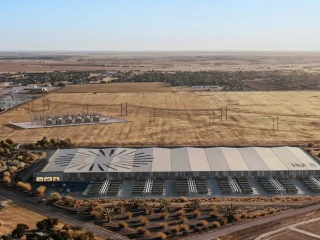
Crypto-miner turned AI infrastructure provider Hut 8 (NASDAQ: HUT) has signed a second lease at its Beacon Point data centre campus in Nueces County, Texas.
The second phase of the project sees Hut 8 secure another 15-year, US$9.8 billion lease for 352MW of IT Capacity.
While the tenant for the project was kept anonymous, Hut8 disclosed that it was the same “high-investment-grade company” that signed the first 15-year lease at the 1GW campus in May.
This customer is now contracted for 704MW of IT capacity at Beacon Point, fully commercialising the site against its 1,000 MW of utility capacity from AEP Texas.
The agreement is structured as a triple net (NNN) lease executed on “substantially the same terms as the Phase 1 lease”, with a 3% annual base rent escalator.
Across both contracts, the campus is expected to generate US$19.6 billion in lease payments over the next fifteen years.
Three 5-year renewal options per lease increase potential campus-level contract value to US$50.2 billion if all options are exercised.
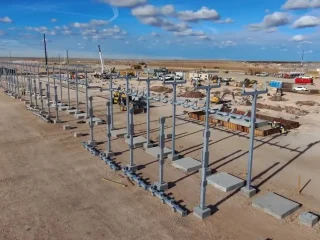
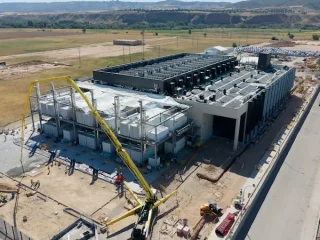
The first and second phases of the development are under construction, with delivery of the second phase data halls expected in Q2 2028. Initial energisation remains on schedule for Q1 2027, Hut8 said in an update.
The lack of details around the tenant implies that it is a big tech firm like Google, Meta, Microsoft or Amazon, who prefer to keep deals more behind closed doors. Hut 8 has also signed a lease with Anthropic for its Riverbend campus.
In a letter to shareholders published shortly after the first 15-year lease was signed at Beacon Point, Hut 8 CEO Asher Genoot said the company has an 8.5GW development pipeline, which is “continuing to be advanced”.
Last year, Hut 8 carved out its Bitcoin mining operation into American Bitcoin (ABTC), a company led by Genoot and US President Donald Trump’s son, Eric Trump.
The relationship with American Bitcoin empowers Hut 8 to pursue what it describes as a “power-first strategy”.
“We do not underwrite around only one customer, one architecture, or one end market. The site was originally underwritten on a speed-to-power thesis. That’s why our relationship with ABTC is so valuable. It gave us a real demand path, and an economics use case even before we had an AI customer finalised,” Ganoot told analysts about Beacon Point.
Simply put, being able to fall back on demand from ABTC’s mining operations means Hut 8 can take more risk acquiring land, power and beginning site development before securing a tenant.
In the case of Beacon Point, this is exactly what happened. However, the change in use case also means that Hut 8 needs to be flexible with its engineering design.
When the campus was first redesigned for its AI use case, the first data hall was scoped for 224 MW of IT capacity, sized to the chip architectures commercially deployed at the time.
As NVIDIA’s reference architectures were updated for materially higher rack-level power densities, Hut 8 says it redesigned the data hall to support the 352 MW AI factory, representing a 57% increase over the initial design, within the same land and utility footprint.


 Facebook
 Youtube
  TikTok
 Threads
 WhatsApp