A report on the panel discussion at infra/CAPITAL Summit 2026 in Paris, hosted by The Tech Capital and Structure Research
After two years dominated by inves...
There’s a line in the movie BlackBerry that always stays with me:
“The problem is there’s only a minute in a minute.”
That is what today’s connectivity market is experiencing. AI demand is rising faster than any business model can adjust. Data traffic keeps exploding. Governments insist on data sovereignty. Investors want returns. Yet spectrum, power and sustainable capital investment are not expanding at the same pace or proportion. We are entering a world where intelligence must be delivered faster than ever, but we cannot manufacture more “minutes”, and now data, in the system.
What follows is a clearer look at why the current AI infrastructure model is reaching its limits – and why the next big shift in digital infrastructure may not be a giant data centre, but the edge sitting on the towers and small cells could potentially be the solution, say in the next decade?
Data keeps growing, but value has shifted to the digital or over-the-top (OTT) players
The telecom ecosystem today serves 5.8 billion mobile data users across 800 telecom operators. The average person spends 6 hours and 38 minutes a day on digital screens and uses about 22GB of mobile data each month, adding up to nearly 150 exabytes of monthly traffic. Today, 70% of this traffic is videos, and a third of those are on five OTT players: Meta, Google, Netflix, Amazon and TikTok; where this data traffic travels through four layers of the digital stacks:
Access layer, where telcos, towercos, and equipment suppliers operate
Transport layer, across terrestrial and subsea networks
Training layer, where massive AI models such as LLMs are built
Compute layer, where GPUs perform inference, machine learning, and scientific workloads.
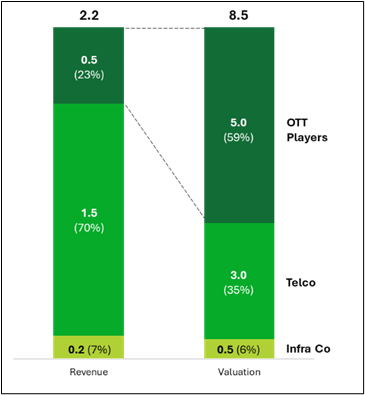
Figure 1: Revenue vs valuation by industry segment, 2025, USD tn (Source: Ericsson Mobility Report)
Despite going across these layers, the economic value captured is not evenly distributed. If you plot revenue against valuation, a familiar pattern emerges: telcos and infrastructure players carry the traffic and much of the capex burden, while the highest valuations sit with the digital platforms, cloud providers and OTTs that monetise the behaviour generated on those networks.
In short: the “data decade” enriched the few who monetise the data – not those transport it.
The world’s compute is concentrated and uneven
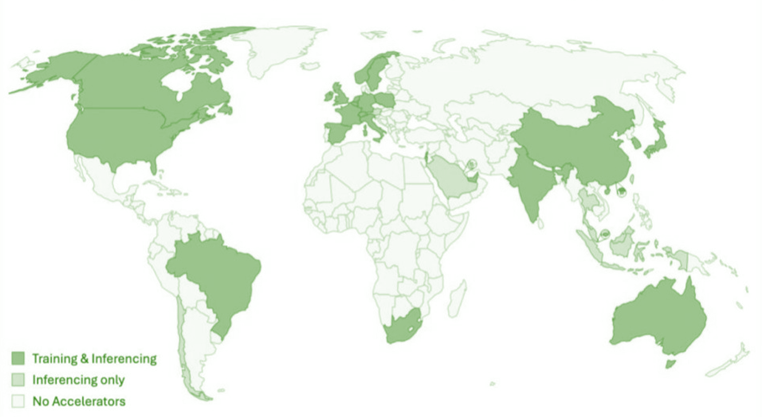
Most of the world’s computing (GPUs – Graphics Processing Units) is housed in a relatively small number of hyperscale data centres, heavily concentrated in the United States and China. This centralised model works extremely well for OTT economics: keep GPUs highly utilised, run training workloads at scale, and return only the lighter inference outputs to users. But what is efficient for hyperscalers does not always serve the broader ecosystem – and the challenge is beginning to surface.
Figure 2: Public cloud AI compute availability by country (Source: Oxford Research)
Centralised AI has a structural problem: power
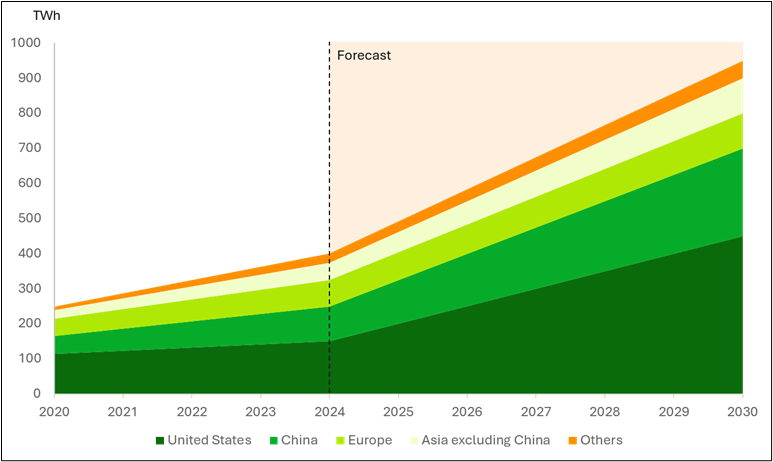
AI is not just data-hungry; it is power-hungry. Data centres today consume around 1.5% of global electricity, and the International Energy Agency warns this could approach 3% by 2030 as AI accelerates. Hyperscale data centres, is expected to increase from 1,200 to 2,000 globally by the end of decade.
Power and cooling are the industry’s hardest limit; even when capital is available, grid capacity often is not. Several countries have already delayed new data-centre approvals for this reason.
Figure 3: Data centre energy growth, ‘20 to ’30, TWh (Source: International Energy Agency)
The power crunch phenomenon leaves the industry with two broad architectural directions:
Option 1: Move compute out – even into outer space
Some firms are experimenting with space-based data centres where solar power is nearly unlimited, cooling is free (cold vacuum of space is a near-perfect heat sink) and reduced latency for global distribution. It’s intellectually bold, but operationally complex and costly.
Option 2: Move compute closer to the user – AI at the edge
The more practical path, especially for Asia, is to keep AI training in hyperscale centres but move inference (the response-generating part) closer to users. Towers, small cells, rooftop sites and street furniture become micro-compute nodes – places where sites could be aggregated and green energy could be applied. For instance, Malaysia’s energy regulators are coming out with programmes that allow corporations to apply green energy in aggregated locations.
This “cell on edge” idea reduces backhaul (not every request travels to a distant cloud), lowers latency, and, critically, supports national sovereignty requirements.
The rise of Sovereign AI
Around the world, nations are enforcing stricter data-localization rules, requiring certain AI workloads and data to stay within their borders—a trend seen in Malaysia, Indonesia, India, Saudi Arabia, and the EU. Rather than focusing only on expanding coverage or capacity, national AI strategies now prioritize “digital sovereignty” and “trusted infrastructure.” Some governments are going further by restricting foreign technology in critical AI systems, including limiting the types of GPUs allowed in local data centres.
Meanwhile, the “Big 5” cloud and platform companies are investing heavily in AI. They are launching multi-billion-dollar data centre projects across North America, Europe, and key Asian hubs, securing long-term GPU and custom chip deals, and investing significantly in subsea cables and new cloud regions. Trillions in market value now hinge on this AI bet.
But a pressing question remains: can today’s AI cloud model ever be sustainably profitable? Major banks like JPMorgan have pointed out that large language models are extraordinarily expensive to operate.
Even headline services like ChatGPT may struggle to cover their soaring compute and energy costs through current revenue models. This reality is making some form of architectural decentralisation not just optional, but imperative.
Why towers and small cells are natural homes for edge AI
Looking ahead, experts predict our digital world is about to change dramatically. By 2030, cities may need vastly more wireless capacity to keep up. By 2040, a new generation of super-fast 6G networks will be standard, connecting billions of smart devices.
Interestingly, most of this mobile traffic won’t be spread out, According to predictions in the GSMA’s Vision 2040, it’s expected to come from just 5% of the land area, concentrated in busy urban hubs.
These hubs, like downtown cores, transportation centres, and business districts, are precisely where cellular towers and equipment are already located. The companies that own this infrastructure provide the essential space, power, and connections for our mobile networks today.
With some upgrades, these urban sites could transform into local AI data centres, equipped to handle advanced computing tasks. In this future, tower companies would do more than just host antennas; they’d become neutral hubs for AI, generating revenue from hosting powerful computers and offering new smart services. This shift helps everyone by enabling faster responses, better data control, and improved energy use.
Zooming out, the emerging “digital nation” model can be expressed quite simply: 5G + AI + Sovereign
5G – and soon 6G – provides the high-capacity digital fabric that carries extraordinary volumes of data.
AI delivers the intelligence layer that powers applications, automation and productivity.
And “sovereign” ensures that countries retain meaningful control over their data, critical infrastructure and long-term digital destiny.
For this to work, a smart, layered setup is key:
Hyperscale data centres will continue to anchor AI training and support global platforms.
Regional and national data centres will handle regulated workloads and host sensitive data that must remain within the country.
Edge sites on towers, small cells, and micro-data centres will deliver latency-sensitive and sovereign AI inference, close to the users and enterprises that need it most.
This isn’t about replacing the cloud, but about completing the picture: Creating a distributed, efficient, and sovereign system powerful enough to support the next era of digital growth.
Case study: Indonesia’s AI-RAN experiment: AI at the network
Indonesia is one of the first countries openly testing a hybrid model. Indosat Ooredoo Hutchison, NVIDIA and Nokia are developing an AI-RAN Grid that pushes AI deeper into the radio network. Instead of treating towers as passive endpoints, this approach turns selected sites into distributed AI compute nodes.
This model links central AI facilities with distributed RAN sites across the country, turning towers into edge-compute points. Importantly, it is tied to Indonesia’s digital sovereignty ambitions: keeping data and compute local while enabling new use cases in education, agriculture, healthcare and public services.
What industry players should do next
For Asia and companies like EDOTCO, the future depends on collaboration. Telecom operators, tower companies, cloud providers, and governments must work together to build the next generation of local AI networks.
The first step is to focus efforts on key urban areas; the dense city centres and business districts where most future AI traffic is expected. Next, we need to agree on common standards for these AI sites, ensuring they have efficient cooling, reliable power, security, and space for advanced computing hardware. Crucially, tower companies should act as neutral partners, providing the infrastructure that allows telecom and cloud companies to expand their services, rather than competing with them.
Government rules and policies must also align with this vision. Local AI hubs can naturally help meet goals for data sovereignty, efficient wireless spectrum use, and national AI plans. Early discussions with regulators will speed up approvals and ensure everyone is on the same page.
Most importantly, this vision needs proof. Pilot projects must demonstrate real benefits: lowering network costs, improving service speed and reliability for users, and creating new sources of revenue. Once the financial advantage is clear, widespread adoption will follow.
If we move compute closer, the Minute becomes more valuable
There is still only a minute in a minute. That hasn’t changed. But we can make that minute dramatically more valuable by shifting intelligence closer to the people, devices, and places that need it.
Edge AI gives nations more control, users better performance, and infrastructure providers a meaningful opportunity to participate in the AI economy rather than being left at the margins. The future of AI will not be built in a handful of hyperscale data centres. It will be distributed across thousands of physical sites – towers, rooftops, small cells – woven into the fabric of our cities.
And if Asia acts decisively, its towers won’t just carry signals. They will carry intelligence. They will carry sovereignty. They will carry the next decade of digital growth.


 Facebook
 Youtube
  TikTok
 Threads
 WhatsApp