Qatar and the United Arab Emirates are set to join Pax Silica, a US-led initiative aimed at securing AI and semiconductor supply chains, according to Undersecretary of State for Economic Affairs Jacob Helberg.
In an interview with Reuters, Helberg said their inclusion was notable given the region’s political divides, and reflects a US effort to bring Israel and Gulf states into a shared, technology-focused economic framework.
He said the “Silicon Declaration” underpinning Pax Silica was intended as an operational document setting out a new approach to economic security. The UAE and Qatar were shifting from a hydrocarbon-driven security framework towards one shaped by “silicon statecraft”.
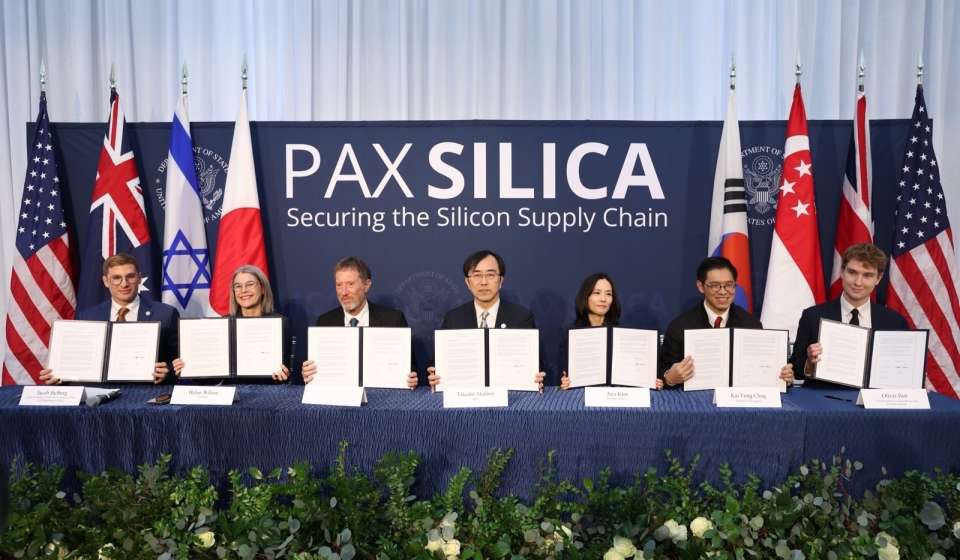
Pax Silica was launched in December, with the US signing the declaration alongside Japan, South Korea, Singapore, Israel, Australia, and the UK. The Netherlands, the UAE, and Taiwan also took part.
Participants were presented as covering key nodes of the AI supply chain. Japan was cited for advanced manufacturing, South Korea for semiconductor production, and Singapore for logistics and connectivity.
Israel was highlighted for cybersecurity, frontier technology, and chip design, while Australia was positioned as a key source of critical minerals. The UK was pointed to for AI research and companies such as DeepMind.
Helberg described the initiative as a “coalition of capabilities”, with membership shaped by each country’s industrial strengths rather than formal alliance structures.
He said Pax Silica’s priorities for 2026 include expanding membership, backing projects to secure supply chains, and aligning policies to protect critical infrastructure and technology. The group is expected to meet several times this year.
AI infrastructure race
In a press briefing last week, Helberg also said the US wanted to “hit the ground running” in 2026 with cooperation across minerals, fabrication, and compute clusters, and develop investment pipelines for mineral projects, expanded fab capacity, and next-generation computing centres.
The aim was a coordinated framework that reduces single points of failure and avoids coercive dependencies in strategic supply chains.
The expansion of Pax Silica comes as Washington steps up efforts to align allies around AI and semiconductor supply chains, as competition with China intensifies.
Alongside export controls targeting advanced chips and AI systems, the US has increasingly focused on coordinating policy, capital, and infrastructure with partners.
Last month, the Trump administration said it would impose tariffs on Chinese semiconductor imports but delay implementation until June 2027. The move followed a year-long Section 301 investigation launched under Joe Biden into China’s exports of legacy chips, and was framed as a way to retain leverage while managing supply chain risks.
This latest development with the Gulf countries shows how Washington is pairing trade and export controls with efforts to align partners around the wider AI supply chain, from chips and manufacturing to energy, minerals, and data centre infrastructure.
This also marks the latest development in the US-UAE tech partnerships. Last year, during President Donald Trump’s visit to the UAE, the two countries announced plans for a 5 GW AI data centre campus in Abu Dhabi. The site is intended to support US hyperscalers and large enterprises, providing regional capacity with access to markets across the Global South.
As part of the agreement, OpenAI launched Stargate UAE. The Abu Dhabi facility is due to come online in 2026 with an initial 200 MW, scaling to a 1 GW AI compute cluster over time.


 Facebook
 Youtube
  TikTok
 Threads
 WhatsApp