South Africa has launched satellite internet and satellite phone services through a partnership involving Space42 (ADX: SPACE42), BrainSAT South Africa and Thuraya.
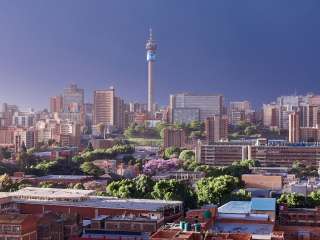
South Africa’s Vice President Paul Mashatile unveiled the services in Johannesburg under the government’s SA Connect strategy, which aims to expand digital access across areas that remain poorly served by fixed and mobile broadband networks.
The programme will see BrainSAT South Africa oversee local implementation of the partnership.
The company provides satellite communications services to government and enterprise customers and will support deployment in areas where traditional broadband infrastructure is either too expensive or technically difficult to build.
Mashatile said the initiative was intended to narrow access gaps affecting education, public services and economic participation in remote communities.
“We want a young boy in a rural village, who once had to walk kilometres just to borrow textbooks from a distant school library, to now have full access to digital connectivity. From his home, he should be able to log into online learning platforms, attend virtual classes, and connect with mentors across the world,” Paul Mashatile, Vice President of South Africa, said.
The launch follows a memorandum of understanding signed between Space42 and South Africa’s Department of Communications and Digital Technologies after Mashatile visited the United Arab Emirates in April 2024.
Space42, a UAE-based space technology company, has been expanding its satellite communications footprint across Africa. In January 2025, the company launched Thuraya-4, a mobile communications satellite carried by a SpaceX Falcon 9 rocket, giving the group full African coverage for the first time.
The company also raised US$695.5 million in July 2025 to finance the development of its next-generation geostationary satellites, Al Yah 4 and Al Yah 5.
Those satellites are expected to support future capacity and service expansion across markets where satellite connectivity can complement or replace ground-based infrastructure.
South Africa remains a relatively small satellite broadband market compared with other forms of wireless connectivity.
According to the Independent Communications Authority of South Africa, the country had 13,667 satellite broadband subscriptions in 2024, accounting for less than 2% of all wireless broadband subscriptions.
That low penetration rate has created an opening for satellite operators and service providers targeting communities beyond the reach of fibre and conventional mobile networks.
Rural connectivity remains a policy priority in South Africa, where uneven network coverage continues to affect access to online education, healthcare, government services and digital commerce.
The partnership also reflects the UAE’s broader effort to increase its technology and infrastructure presence in Africa through government-to-government engagement and commercial partnerships.
South Africa is one of the continent’s largest digital infrastructure markets, but coverage gaps remain significant outside major urban areas.
For Space42, BrainSAT and Thuraya, the rollout offers access to a market where satellite broadband remains underdeveloped, but where demand is expected to grow as public services, schools and businesses become more dependent on reliable internet access.
The companies are targeting areas where terrestrial broadband deployment is constrained by geography, cost, or limited commercial returns. Satellite services can be deployed without the same level of civil engineering works required for fibre or fixed network infrastructure, making them a practical option for low-density areas.
The South African government has positioned the initiative as part of its wider digital inclusion agenda, with SA Connect serving as the main policy framework for expanding broadband access to public facilities, communities and households across the country.